There's an old investing rule called "don't fight the Fed." This means that what the Federal Reserve (the country's central bank) does with interest rates can affect the stock market and economy. So investors should pay attention to these decisions. But it's important to look at the big picture of where rates are heading, not just focus on each individual Fed meeting.
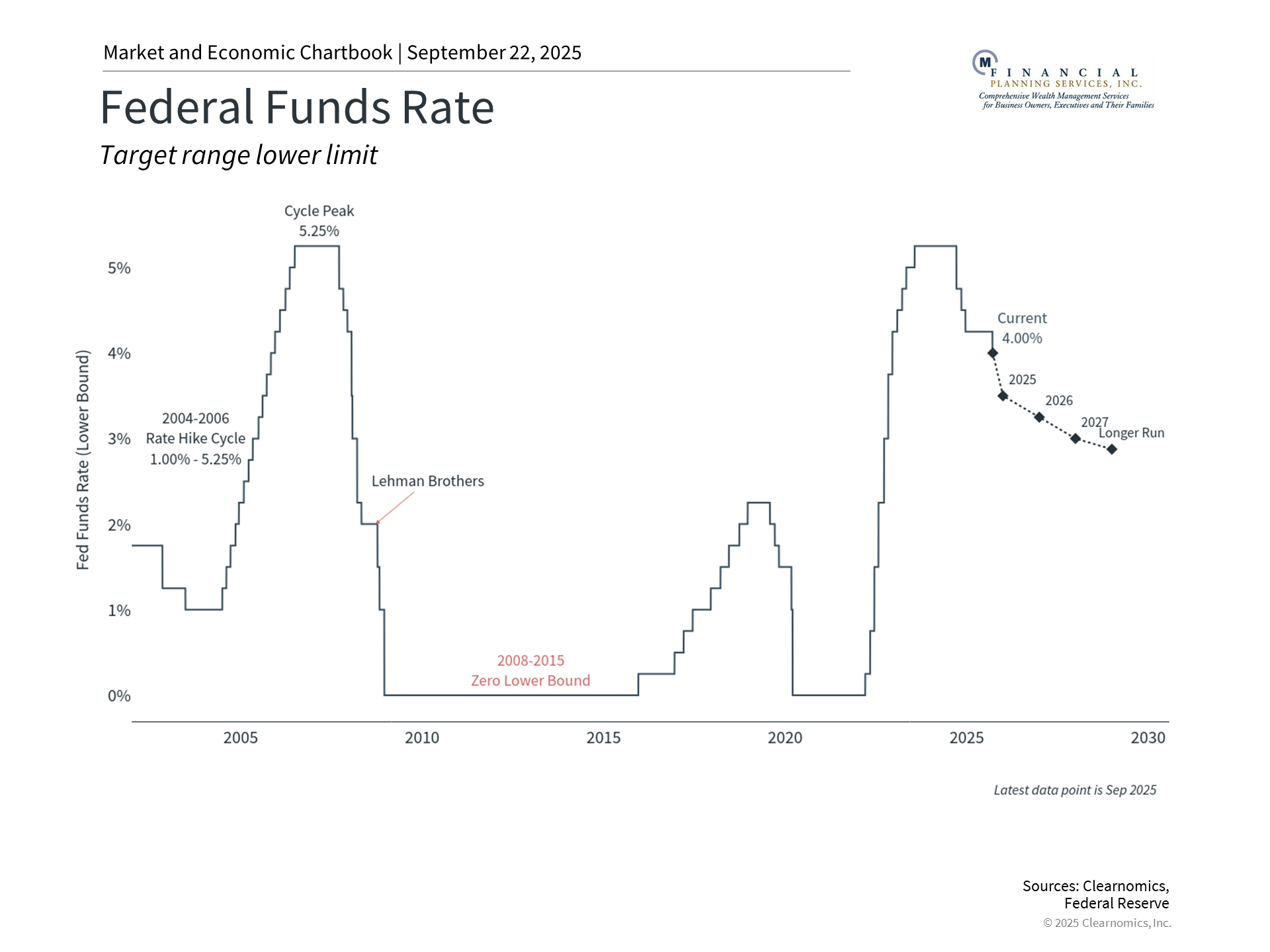
The Fed recently cut interest rates by 0.25%, which was expected. This continues the rate-cutting cycle that started in 2024. The Fed made this decision while stock markets are near record highs, economic data is mixed, and there's still uncertainty about tariffs and inflation. Unlike emergency rate cuts during the 2008 financial crisis or 2020 pandemic, today's cut is meant to fine-tune the economy to keep it growing, not respond to a crisis.
For long-term investors, it's helpful to understand why the Fed is cutting rates and how this situation is different from past cycles. Rate cuts usually help financial markets, but the key is keeping perspective and staying focused on long-term goals instead of overreacting to each policy change.
Why the Fed cuts rates matters more than when or how much
 |
Fed officials look at economic data like growth, jobs, and inflation to make decisions. When the economic outlook is unclear, Fed officials often disagree about future rate cuts. This is happening now, with officials having different views on upcoming rate changes.
Despite these disagreements, a few things are important to remember. First, the Fed has been planning to cut rates for some time. Their published forecasts showed rate cuts were likely to begin this year. The Fed's latest projections suggest there could be two more cuts this year, along with an improved growth outlook.
Second, today's rate cuts are different from past cutting cycles that were mostly driven by emergencies. Current rate cuts are reversing the rapid rate increases that began in 2022 to fight inflation. They're happening while the economy is softening but still positive. This is very different from large emergency cuts due to financial system problems or economic crises.
Recent economic data shows mixed signals
 |
A main reason for the Fed's decision was weakening in the job market. The economy added only 22,000 jobs in August, well below expectations. The unemployment rate only rose slightly to 4.3% because fewer people were looking for work. This is different from past emergency periods when unemployment spiked much higher.
While a weakening job market supports lowering rates, inflation concerns support keeping rates steady or even raising them if tariffs drive prices higher. The Fed's preferred inflation measure, called PCE, is at 2.6%, above their 2% target. Core PCE is at 2.9%, while other inflation measures remain sticky between 2.9% and 3.1%.
The Fed must balance these factors as part of its "dual mandate" (managing both employment and inflation). The mixed signals explain why there's disagreement within the Fed and with the White House. For investors, understanding these trends is more helpful than watching daily political headlines.
Rate cuts generally help businesses and investors
For investors, the key question is whether rate cuts happen during a recession or support continued growth. While there are some signs of economic weakness, there aren't clear signs of recession yet. In these situations, rate cuts typically provide broad benefits across financial markets. Lower borrowing costs make it cheaper for companies to finance growth and reduce debt payments. Consumer spending can increase if mortgage and credit card rates decline.
One concern is that the stock market is already near all-time highs. While this isn't typical, it has happened before. For example, the Fed cut rates in 1995-1996 and 2019 when markets were at highs. Fed Chair Powell described this recent decision as "a risk management cut" due to rising employment risks.
History shows that rate cuts are generally positive for different types of investments. Stocks typically benefit as lower rates make future company earnings more valuable and improve corporate profits. Bonds typically become more valuable due to their higher rates. In contrast, cash will likely have lower returns, making investments like stocks and bonds more attractive.
The bottom line? The Fed's latest rate cut may support the economy amid mixed signals. Investors should maintain a long-term perspective, focusing on overall market direction rather than individual Fed decisions.